



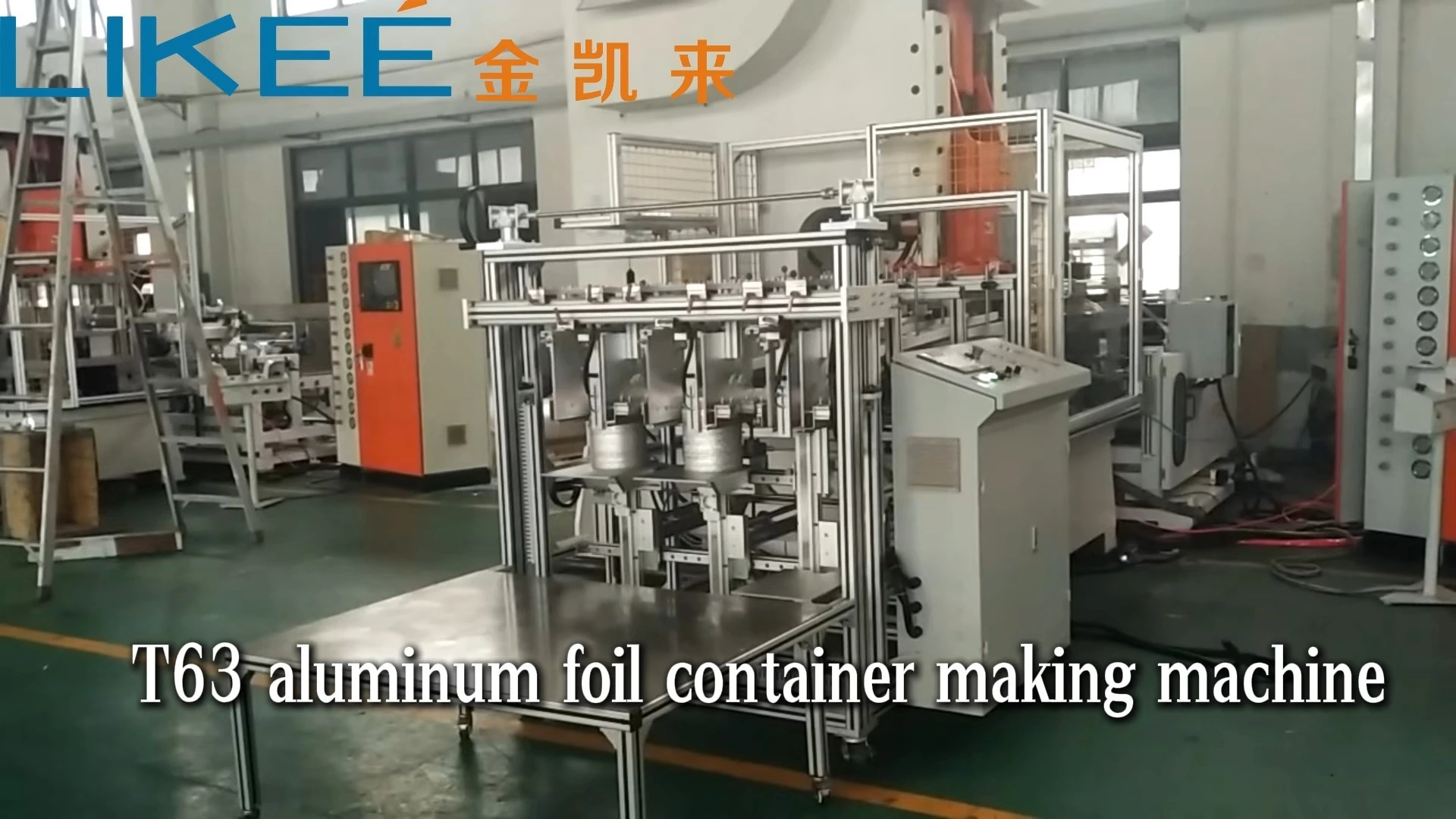
LK-T63 China Source Factory Mitsubishi Electronic Containers Aluminium Foil Food Trays Production Line
Aluminum foil container making machine Detailed Product Description
1.System Design for Container Production
This LK-T63 Aluminum foil container making machine is optimized for aluminum foil container manufacturing. The entire process, from servo feeding and stamping to finished product stacking, runs in an automated, continuous cycle. The use of a Mitsubishi control system allows for steady management of parameters like production speed and feeding accuracy, contributing to consistent product quality.
2.Automated Process for Simplified Operation
Considering the need for operational ease on the production floor, the equipment design focuses on simplifying human-machine interaction. The operator's primary tasks are monitoring equipment status, replenishing raw materials, and transferring finished goods. The intuitive touchscreen interface lowers the skill barrier, while the quick mold change system reduces preparation time for product switches.
3.Configuration Choices for Long-Term Operation
The LK-T63 Aluminum foil container making machine features a robust C-frame structure that provides a stable foundation for continuous running. The control system and key drive components are selected from industrially proven brands like Mitsubishi. This configuration approach helps minimize unplanned downtime and maintain steady production rhythm.
4.Flexibility for Different Production Processes
The production line is compatible with both wrinkled and wrinkle-free container processes, the two mainstream technologies. You can choose the corresponding molds for production based on order requirements. We provide supporting services from mold design to equipment commissioning.
Aluminum foil container making machine Product Specifications
| Item | Specification |
|---|---|
| Model | LK-T63 |
| Stamping Force | 63 Tons |
| Mold Compatibility | 3-Cavity Molds |
| Production Speed | 35-68 Strokes/Minute |
| Average Speed | ~50 Strokes/Minute |
| Equipment Power | ~19.8 KW |
| Power Supply | 380V / 50Hz / 3-Phase |
| Control System | Mitsubishi PLC & Touchscreen |
Aluminum foil container making machine Key Features
-
Stable System Control: Uses Mitsubishi control system for accurate parameter management.
-
High Automation Level: Fully automated process enables single-operator control.
-
Good Process Compatibility: Supports both wrinkled and wrinkle-free container production.
-
Flexible Production Switching: Equipped with quick mold change and multi-set parameter memory.
-
Intuitive Fault Indication: Touchscreen directly displays fault information for easier troubleshooting.
Aluminum foil container sample
Exhibition Participation
Customer Questions about aluminum foil container making machine
Q1: How does the Mitsubishi control system perform in actual production?
A1: The system responds stably, accurately controlling stamping and feeding actions, which helps reduce product variations caused by control fluctuations.
Q2: What is the automation level of the production line? How many operators are needed?
A2: The entire process from raw material to finished product is automated. Only one person is needed to monitor, handle material loading/unloading, and execute mold change commands.
Q3: Can the equipment handle both wrinkled and wrinkle-free container production?
A3: Yes. The main difference between the two processes lies in the molds. The production line itself is compatible with both requirements.
Q4: If a fault occurs, how can we quickly identify the problem?
A4: The equipment touchscreen directly displays a fault code and a brief description, such as "Feeding Error" or "Stacker Alarm," facilitating initial diagnosis.
Q5: How long does it typically take from installation to going into production?
A5: For teams with relevant experience, following the provided guidance documents, mechanical installation and basic commissioning can usually be completed within a few days.
WhatsApp: 0086-18930097829